


Since its launch, millions of households have saved money on their energy bills thanks to the Demand Flexibility Service (DFS). The scheme, which is available via a number of UK energy suppliers, allows customers to reduce their energy usage during a set timeframe to relieve stress on the energy system at peak times.
Participating customers who manage to successfully reduce energy usage during the timeframe specified are rewarded with money off their energy bill as well as other incentives. The amount of money rewarded varies depending on the energy supplier and the amount of energy saved. The National Energy System Operator (NESO) has confirmed that the Demand Flexibility Service is now a year-round service. Following a successful transition in November 2024, the scheme is no longer limited to the winter months, although events are still most likely to occur during periods of high demand during winter. This gives households continuous opportunities to save money on their energy bills.
In this article, we look at how the Demand Flexibility Service works, who is eligible to take part in the Demand Flexibility Service and additional ways in which you can save on your energy bills.
How does the Demand Flexibility Service work?
The Demand Flexibility Service was launched by the National Energy System Operator (formerly National Grid ESO) to reduce demand on the energy network during peak usage. The scheme was launched after a number of successful trials and delivered significant energy reduction across the network. The scheme works by encouraging households to reduce their energy consumption during peak times. DFS tests typically last for 1 hour and live events are likely to last up to 4 hours. The tests and live events are most likely to take place on weekday evenings when electricity demand is often at its highest.
Unlike previous years, where the service ran only from November to March, the DFS now operates year-round as part of the standard toolkit used to balance the electricity network. This means it now competes directly with power plants to help manage the grid.
The amount of money you save if you participate in the scheme will vary depending on your individual energy supplier and how much energy you save. Previously, the scheme offered a guaranteed minimum price to suppliers, but it has now moved to a competitive "merit-based" system. This means suppliers bid to provide flexibility, and the rewards passed on to you will depend on market conditions and your supplier's specific offer. Rewards may be given as points, prizes, bill credit or cash. At present, numerous domestic energy providers are registered to take part in the scheme.
When the DFS scheme was first announced, some safety concerns were raised, especially as consumers could be encouraged to use electrical appliances overnight. Electrical Safety First issued the following guidance to help consumers to stay safe when using electrical appliances.
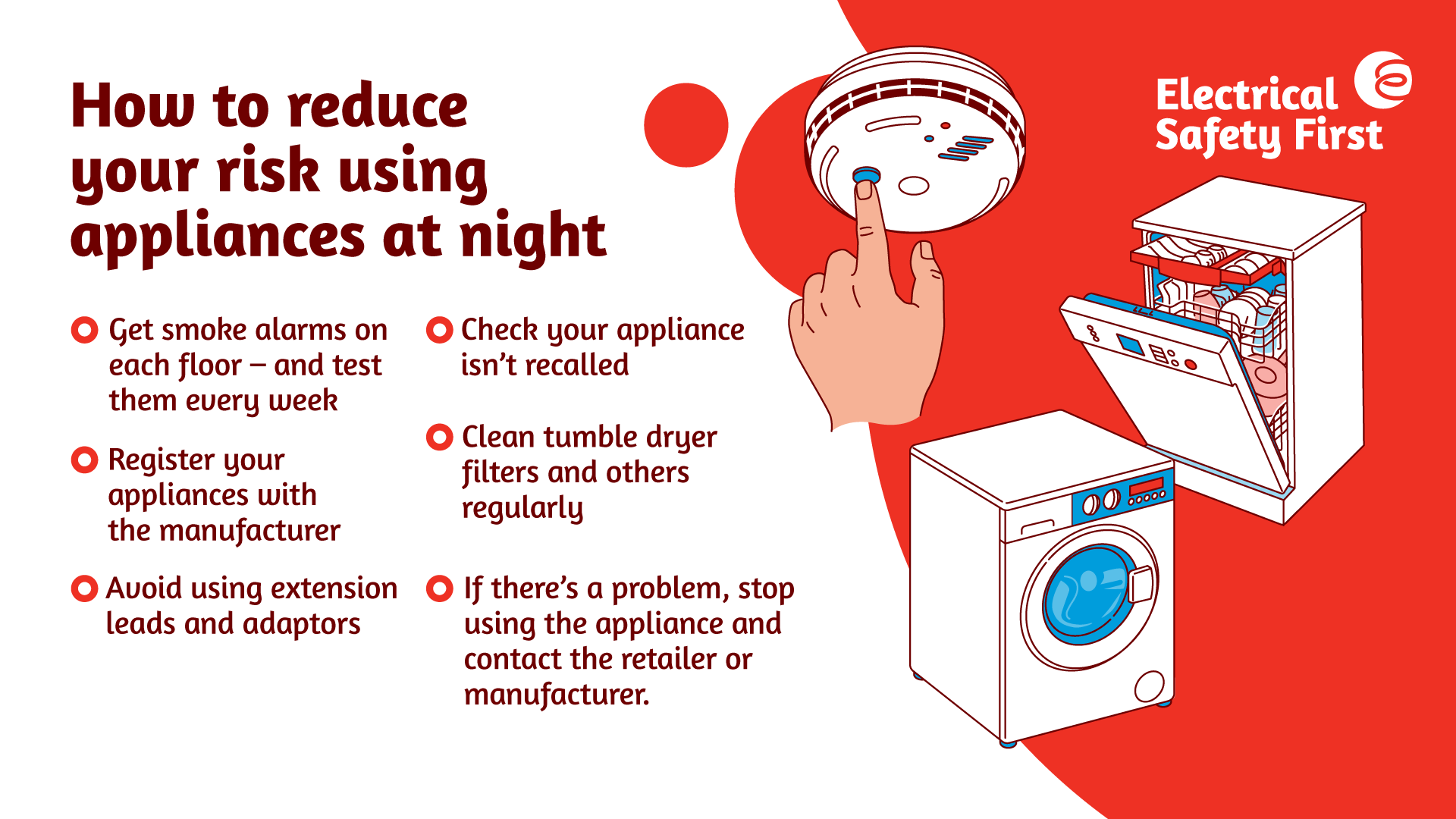
(Click to enlarge)
Who is eligible for the Demand Flexibility Service?
Participating energy suppliers will contact eligible households to invite them to participate in the DFS scheme. To be eligible you need to be registered with a participating energy supplier and have a smart meter that can provide meter readings every half an hour. Energy suppliers registered for the Demand Flexibility Service can be found in the below comparison table.
What domestic energy providers are part of the Demand Flexibility Service?
The following table shows a selection of domestic energy suppliers that have registered to take part in the Demand Flexibility Service. Please note that participation can change, and some providers may access the service via third-party partners.
| Axle Energy Ltd | 100 Green (via SMS – Solo Energy Ltd) |
Passiv Uk (via SMS – Solo Energy Ltd)
|
| British Gas | Good Energy (via SMS – Solo Energy Ltd) |
Perse Technology Ltd
|
| CarbonLaces Solutions Ltd | Hildebrand Technology Ltd |
Power Rewards App (via Orange Power Ltd)
|
| Chameleon Technology (as Ivie) | Hugo Energy App (via SMS - Solo Energy Ltd) |
Rebel Energy Supply Ltd (via SMS – Solo Energy Ltd)
|
| Easee UK Ltd (via Axle Energy Ltd) | Levelise Limited |
Scottish Power (via Equiwatt)
|
| Ecotricity Group Ltd (via SMS - Solo Energy Ltd) | Loop.homes (via SMS - Solo Energy Ltd) |
SMS (Solo Energy Ltd)
|
| EDF | Octopus Energy |
So Energy (via SMS – Solo Energy Ltd)
|
| E.ON Next | MakeMyHouseGreen (via SMS – Solo Energy Ltd) |
SolarEdge Technologies (via SMS – Solo Energy Ltd)
|
| Foxglove Energy Supply Ltd T/A Outfox The Market (via SMS – Solo Energy Ltd) | Ohme (via Axle Energy Ltd) |
Uswitch Ltd (via Hildebrand)
|
| GivEnergy Software (via Axle Energy Ltd) | OVO Energy |
Utilita Energy Ltd
|
Source: National Energy System Operator (NESO)
How to save money on your energy bills
If you do not have a smart meter, or your provider is not yet participating in the Demand Flexibility Service, there are a number of ways you can still save money on your energy bills. Find out more in our articles, 'How to save money on your energy bills', 'How much electricity am I using?' and 'What is the cheapest way to cook?'

£200 Pension Cashback Offer
Make a qualifying deposit or transfer a pension to our partner Interactive Investor.
- Deposit or transfer a pension of at least £20k and you could earn £200 cashback
- Terms and Fees apply, Capital at risk
- New & Existing customers opening a SIPP
- Offer ends 31st July 2026
Before starting your transfer, check you won't lose any valuable benefits (such as guaranteed annuity rates or a lower protected pension age) and find out what exit fees you might have to pay

