

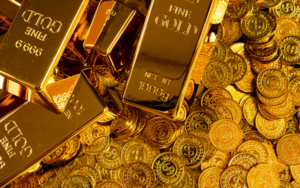

This historic milestone follows an exceptional 2025, during which the price of gold rose by more than 65%, and continues a 2026 rally that has already seen gold gain approximately 18% since the start of January.
Why is the gold price rising?
The rise to $5,000 per ounce is the "perfect storm" of numerous overlapping macroeconomic and geopolitical factors that increased the demand for gold.
In 2025, the rally was largely driven by a move away from the US dollar. Central banks around the world began swapping their dollar reserves for gold to protect themselves from inflation and trade war disruptions. The value of the US dollar against a basket of global currencies fell by 9% in 2025, marking the worst year since 2017. As gold is priced in US dollars, when the US dollar falls in value gold becomes more attractive to buy for investors holding currencies other than the US dollar.
Gold also benefited from the return of institutional investors to gold ETFs (funds that track gold prices), which created a rise in demand for the metal, which pushed prices higher. In addition, geopolitical risks, such as President Trump's trade war and associated tariffs saw investor demand for gold increase as a haven asset as bond and equity markets wobbled.
As we moved into 2026, gold did face a potential banana skin. After surviving a late 2025 bout of profit-taking, the gold rally faced a much larger forced-selling event in the first half of January, as a result of the annual rebalancing of the Bloomberg Commodity Index (BCOM). After gold achieved stratospheric gains in 2025, index-tracking funds were mechanically required to sell an estimated $5.6 billion in gold futures between January 8th and 15th to bring their gold weightings back in line with target caps. Historically, such mass sell-offs act as a significant technical headwind. However, the price of gold not only navigated the rebalancing period but also set new all-time highs. This strength attracted even more investors.
In the US, the Department of Justice’s criminal investigation into Federal Reserve Chair Jerome Powell rattled investment markets. Investors are worried that political pressure is stripping the Federal Reserve (which is the US's equivalent of the Bank of England) of its ability to manage the economy independently, making US-backed assets feel less secure.
With global debt also hitting record levels and interest rates falling in major economies, the "opportunity cost" of holding gold has vanished. With bonds offering lower returns and higher risks, gold has become the chosen insurance policy for both retail buyers and massive institutional portfolios.
These last two points lead to something called the gold "debasement trade" where investors use a defensive strategy and swap "paper" money for "hard" assets like gold because they fear governments (like the US) are intentionally or accidentally destroying the value of its own currency. Investors now believe that, with out-of-control national debt and political interference at the Federal Reserve, one way for the US government to stay solvent is to get its central bank to effectively print more dollars, which devalues the value of the US currency. As an investor, one way to protect your wealth is to swap your US dollars for gold.
Elsewhere, escalating geopolitical threats, including the invasion of Venezuela by President Trump and the threat of the US taking Greenland by force, have further increased the demand for gold as a haven for investors. With NATO almost pushed to breaking point and Trump's threat of imposing trade tariffs on any European nation that did not agree to his "purchase" of Greenland, a "Sell America" trade was triggered. European pension funds and global investors began offloading US Treasuries (government debt) and moving that money into gold, an asset that belongs to no government.
On Monday, Trump threatened Canada with a 100% tariff on Canadian goods imported into the US if the country agreed a trade deal with China. This was the catalyst that finally pushed the price of gold over $5,000 per ounce.
Of course, we also have "FOMO" (the Fear Of Missing Out), which is now seeing investors pile into the precious metal in the hope that gold will continue to rally.
How high could the gold price go?
The price of gold finished 2025 over 65% higher than it started the year, making 2025 the best year for gold since 1979. At the start of 2026, major investment banks remained bullish on the outlook for gold, with their end of 2026 price targets clustering between $4,500 and $5,300 per ounce.
However, in the face of the continued rally in gold, a number of investment banks are now revising their 2026 price targets upwards. UBS has increased its gold price target from $5,000 to $5,400, while Goldman Sachs has also increased its 2026 target from $4,900 previously to $5,400.
Bear in mind that investment banks tend to have their views obscured by recency bias. This is true of nearly all investors. Recency bias is the cognitive tendency to believe that recent events will occur again in the near future, often leading to biased and possibly inaccurate assessments. In the case of gold, recency bias would lead investors to make overly optimistic predictions as a result of the strong rally we've witnessed recently.
If the price of gold does instead tumble, some institutional analysts suggest that $4,500 could now be a new floor for the market. If this were true, it would represent a 10% fall from current levels.
When investing, your capital is at risk and you may get back less than invested. Past performance doesn’t guarantee future results.

£200 Pension Cashback Offer
Make a qualifying deposit or transfer a pension to our partner Interactive Investor.
- Deposit or transfer a pension of at least £20k and you could earn £200 cashback
- Terms and Fees apply, Capital at risk
- New & Existing customers opening a SIPP
- Offer ends 31st July 2026
Before starting your transfer, check you won't lose any valuable benefits (such as guaranteed annuity rates or a lower protected pension age) and find out what exit fees you might have to pay

