



Dr Craig Lowrey, Principal Consultant at Cornwall Insight, explains: "Over the past few months, we've watched our forecasts shift from showing virtually no quarter-on-quarter increase to a 13% rise in current bills - with this change due to the impacts of the Middle East conflict."
He also warned that "a summer rise will be painful for households, but the bigger concern is October when household demand traditionally picks up."
The predicted rise represents a significant jump from the latest energy price cap figure of £1,641, which has been in place since 1st April 2026. In this article, we explain the cause of the spike in energy price predictions and whether now is a good time to fix.
What is the energy price cap?
The energy price cap was introduced by Ofgem to set the maximum amount energy providers can charge consumers for each unit of gas and electricity. Ofgem calculates the price cap every three months and takes into account the cost of VAT, wholesale energy prices, and the cost of providing energy. It then generates an annual figure based on the average dual-fuel household that pays via direct debit. It is important to remember that the cap is on the unit rate of energy, not your total bill. Actual bills will always depend on the exact amount of energy a household uses.
Why are energy prices predicted to rise?
The predicted energy price cap increase for July is largely due to a surge in wholesale oil and gas prices, driven by ongoing geopolitical tensions and conflict in the Middle East. Wholesale energy prices jumped significantly during the first three weeks of March, before stabilising in early April. We then saw a period of calm as talks took place, with wholesale prices falling before spiking again mid-April when those talks broke down. We are continuing to witness increased volatility, with the ongoing conflict disrupting major shipping routes and damaging critical infrastructure.
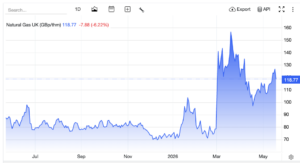

Source: https://tradingeconomics.com/commodity/uk-natural-gas
Latest predictions from major suppliers
To help customers plan their finances, major energy suppliers provide their own forecasts for the upcoming price cap, which are regularly updated to reflect market changes. However, the current extreme volatility in the energy market has made this increasingly difficult. Ofgem is scheduled to officially set the July price cap on 27th May, and this final figure will be based on wholesale energy prices recorded across March, April, and May.
Below is a summary of the latest predictions from Cornwall Insight and three major energy providers: E.ON Next, British Gas, and EDF.
| Source | Predicted Annual Cost from July 2026 | Predicted Annual Cost from October 2026 | Date of Forecast |
| Cornwall Insight | £1,850 | N/A | 19th May 2026 |
| British Gas | £1,850 | £1,945 | 19th May 2026 |
| E.ON Next | £1,849 | £1,923 | 20th May 2026 |
| EDF | £1,847 | £1,929 | 19th May 2026 |
It is worth remembering that energy forecasts remain speculative; the situation in the Middle East is volatile and prices are heavily influenced by the latest geopolitical developments. You shouldn't use any early forecasts to predict your future energy bills, however, they can act as a useful guide.
Is now a good time to fix?
The most immediate impact of rising wholesale gas prices has been seen in the fixed-rate energy market. As wholesale costs have risen, energy suppliers have opted to withdraw or reprice their cheapest fixed-price tariffs to protect their margins. If you have been considering switching to a fixed deal to lock in certainty, the window to secure the lowest rates may be closing. If you have been putting it off, it would be wise to act sooner rather than later. Check out our article 'Should I fix my energy prices?'.
What you should do next
- Check the best fixed-rate deals - Compare the fixed tariffs currently available against the Energy Price Cap. If you value certainty over the risk of future price changes, fixing might be a sensible option. You can check out the latest deals in our article 'What is the cheapest fixed-price energy tariff'.
- Monitor the market - Keep an eye on announcements regarding the July Energy Price Cap, which Ofgem will announce on 27th May.
- Focus on efficiency - The most effective way to lower your bill is to reduce usage where possible. Simple changes, such as lowering your flow temperature or draught-proofing, can make a difference. Check out our article 'How to save money on your energy bills'.
What to do if you are struggling to afford your energy bills
If you are worried about how you will afford your energy bills in the coming months, the most important step is to contact your energy supplier as soon as possible. Your supplier may be able to offer you an affordable repayment plan so that your energy costs remain manageable.
You may be able to clear your debt with your energy supplier via the Fuel Direct Scheme if you receive benefits. Alternatively, you may be able to get help with grants and schemes offered by your energy supplier or with the British Gas Energy Trust, which offers support for customers of all energy companies. For more information on the schemes available, visit the Citizen's Advice website.
There are also a number of charities and organisations that can provide free financial advice. We've provided links to a selection of the best websites below:
- MoneyHelper (previously the Money Advice Service)
- The money charity
- StepChange
- National Debtline
- Turn2us
- Citizens Advice
- Payplan

£200 Pension Cashback Offer
Make a qualifying deposit or transfer a pension to our partner Interactive Investor.
- Deposit or transfer a pension of at least £20k and you could earn £200 cashback
- Terms and Fees apply, Capital at risk
- New & Existing customers opening a SIPP
- Offer ends 31st July 2026
Before starting your transfer, check you won't lose any valuable benefits (such as guaranteed annuity rates or a lower protected pension age) and find out what exit fees you might have to pay

