
 Leading energy market analysts Cornwall Insight are forecasting a £117 a year drop in the energy price cap from 1st April 2026, thanks to measures announced in the 2025 Autumn Budget. The energy price cap currently stands at £1,758 for the average dual-fuel energy bill per year, but Cornwall Insight is expecting a fall to £1,640.74 when the new cap is officially announced on 25th February.
Set by the energy regulator Ofgem, the price cap limits the amount suppliers can charge per unit of gas and electricity (the unit rate) and the fixed daily amount suppliers can charge for being connected to the network (the standing charge). While the predicted drop is encouraging, especially for households on standard variable tariffs (SVTs), which are directly governed by the cap, the energy market remains highly volatile, driven primarily by fluctuating wholesale energy costs and investment in the UK's energy infrastructure. It is worth noting that even if the energy cap falls as predicted, average energy bills will still be considerably higher than they were before the energy crisis began in late 2021.
Why is the energy price cap expected to fall?
The major reason bills are expected to fall is because the government's decision to cut two green levies will come into effect from April. The Energy Company Obligation (ECO) scheme will end, while 75% of the 'renewables obligation', a levy that funds renewables projects, will be taken off electricity bills. The renewables obligation will instead be paid through general taxation, creating an expected £88 saving for average bill payers. Not renewing the Energy Company Obligation (ECO) scheme was expected to save £59 on average, plus a £7 VAT saving from both cuts.
The treasury announced the £154 total saving alongside the changes as part of the 2025 Autumn Budget, but Cornwall Insight analysts are now predicting bills will drop by a lower figure of £117. This has been put down to rising costs associated with operating and maintaining the energy network, and volatility in the wholesale gas market.
Why are energy bills falling by less than expected?
Back in January, we warned that spiking gas prices could undermine the government's efforts to cut bills. While the price of natural gas has fallen, as you can see in the graph below, the wholesale price remains incredibly volatile.
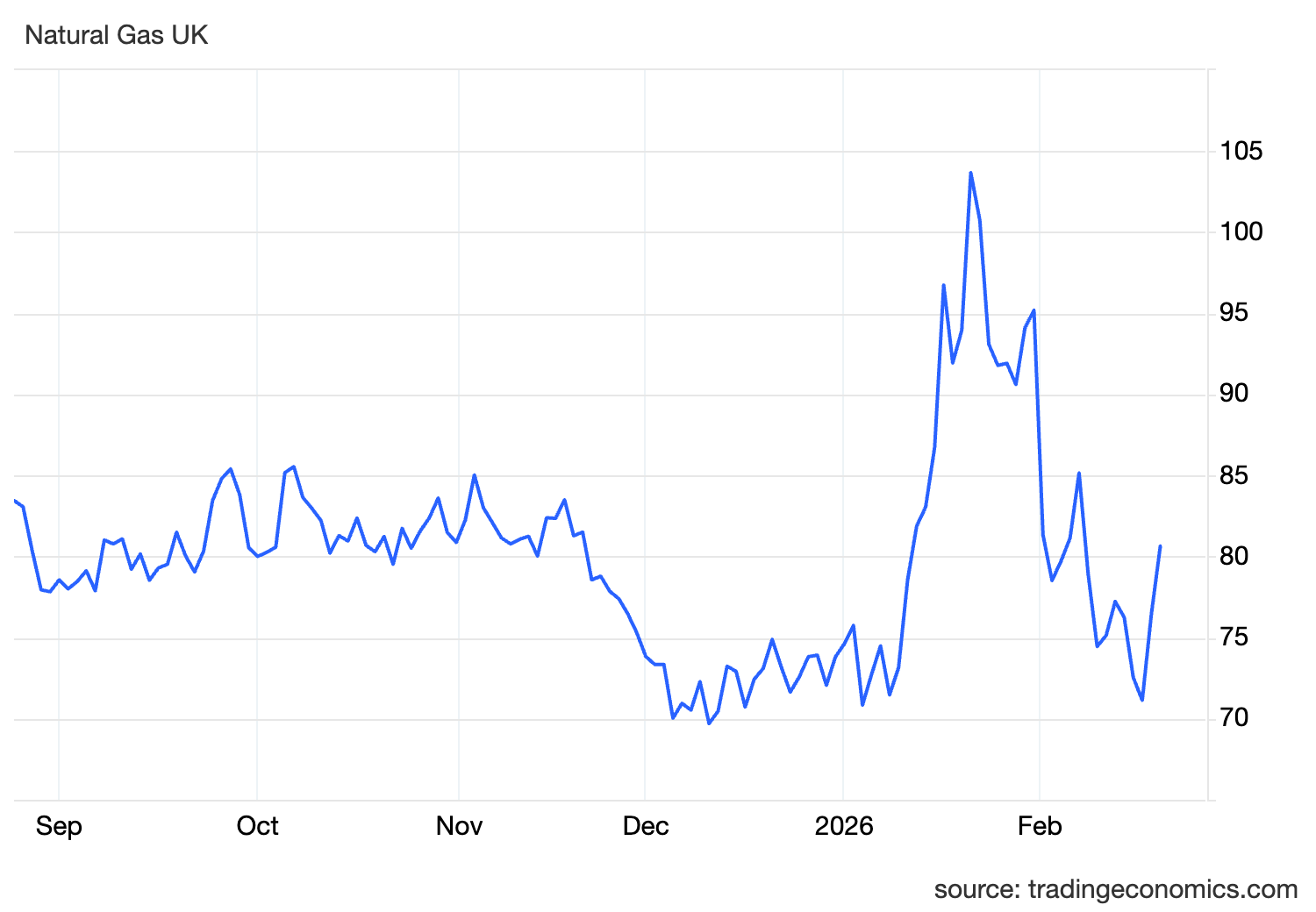
Average energy bills are currently about £425 a year higher than they were in 2022. Part of this, about £170 a year, is because before the Russian invasion of Ukraine and the ensuing European energy market crisis, gas could be imported more cheaply without such a reliance on expensive tanker imports from the US and the Middle East. However, another sizeable chunk, about £143 a year, reflects the costs of the UK’s energy upgrades.
Significant improvements to the UK’s high-voltage transmission grid are taking place, alongside investment into the lower-voltage distribution network that carries power from the transmission grid into buildings. Because of this spending, the standing charge element of customers' bills that contributes towards infrastructure upgrades is expected to go up. Electricity standing charges are predicted to increase from 54.75p to 64p a day, while gas standing charges will rise from 35.09p to 36p a day.
Craig Lowrey, the principal consultant at Cornwall Insight, said: "The real test will be keeping those savings going. That won’t be easy as the UK continues to upgrade its networks and infrastructure. That investment is needed if we want an energy system that is more secure and resilient, after the consequences of exposure to global energy markets were made all too apparent in recent years. However, there needs to be an open conversation about the fact that such a transition will not be cost‑free."
He added: "Bills aren’t going to drop by two or three hundred pounds overnight, but long-term progress is possible if we stick with the transition. Ultimately, a move to homegrown energy gives us a stronger chance of eventually achieving price stability while providing greater energy security in the process."
Energy price cap predictions for April 2026
As well as the latest predictions from Cornwall Insight, three major energy providers now publish regular updates on where they think energy prices will be heading in the coming months. The actual energy price cap is set by the energy regulator Ofgem and is based on a number of factors, including the wholesale price of electricity and gas. Energy providers British Gas, E.ON Next and EDF are able to run this information through their own algorithms to form a prediction on where the energy price cap is likely to be set in the future. We have provided the latest forecasts below.
| Source | Predicted Annual Cost (£) from April 2026 | Predicted Change vs Current Price Cap (£1,758) | % Change vs Current Price Cap | Confidence Level (where stated) | Date of Forecast |
| Cornwall Insight | £1,640.74 | -£117.26 | -6.67% | N/A | 17th Feb 2026 |
| British Gas | £1,635 | -£123 | -7.00% | Low | 16th Feb 2026 |
| E.ON Next | £1,633 | -£125 | -7.11% | Medium | 16th Feb 2026 |
| EDF | £1,640 | -£118 | -6.71% | Medium | 17th Feb 2026 |
Energy price cap predictions for July 2026
Major energy suppliers now provide energy price cap forecasts that stretch as far as early 2027. Current long-range forecasts from major suppliers suggest relative stability or minor fluctuations after the April drop, but with a low level of confidence.
| Source | Predicted Annual Cost from July 2026 (Confidence Level) | Predicted Annual Cost from October 2026 (Confidence Level) | Predicted Annual Cost from January 2027 (Confidence Level) |
Date of Forecast |
| British Gas | £1,610 (Very Low) | £1,605 (Very Low) | £1,615 (Very Low) | 16th Feb 2026 |
| E.ON Next | £1,616 (Low) | £1,626 (Lowest) | N/A | 16th Feb 2026 |
| EDF | £1,602 (Very Low) | £1,605 (Very Low) | £1,625 (Very Low) | 17th Feb 2026 |
Is now the time to fix your energy tariff?
The prediction of a falling energy price cap complicates the decision of whether now is the right time to fix your energy tariff. When prices were consistently rising, fixing offered protection against further increases, but with the prospect of lower variable rates from April, the decision isn't straightforward. Ultimately, there is no single right answer. The best course of action depends on individual circumstances, usage patterns, and tolerance for risk. It is crucial to weigh the pros and cons carefully before making a decision.
What are the pros of fixing your energy tariff now?
Fixing your energy tariff now provides clarity on what you will pay and may help you to budget more effectively. Locking in your unit rates and standing charges for 12, 18, or even 24 months protects you from the market volatility that causes the price cap to fluctuate in the future. Additionally, some fixed-rate tariffs are priced below the level that the energy price cap is predicted to fall to in April. It means that fixing now could lead to immediate savings compared to staying on the current standard variable tariff, as well as offering protection against any future price cap rises. You can compare the latest energy deals below. You can also check out our article 'What is the cheapest fixed-price energy tariff?'.
 Energy Deals
Compare energy deals
Protect yourself against high energy rates by comparing energy deals with Uswitch
- Enter your postcode
- Compare energy deals
- Switch energy in minutes
What are the cons of fixing your energy tariff now?
The main risk of fixing now is missing out on further price reductions. If the energy price cap drops more than predicted in April, or continues to fall significantly in subsequent reviews in October 2026 and January 2027 (although forecasts suggest this is less likely), those locked into a fixed deal could find themselves paying more than necessary or facing an exit fee to change their tariff.
Most fixed tariffs come with early exit fees that can be as much as £150 per fuel. These extra costs reduce flexibility if your circumstances change or if significantly cheaper deals emerge later. Some suppliers, such as British Gas, will often waive exit fees if you decide to switch to another of their fixed tariffs, while others offer fixed deals with no early exit fees.
What if you can't afford to pay your energy bill?
Even with energy bills predicted to fall in April, typical bills remain around £400 higher than they were in October 2021. If you find yourself struggling to pay your energy bills there are a number of things you can do:
- Contact your energy supplier - Notifying your energy supplier that you are struggling to pay your energy bills means that they are obliged to help you find an affordable way for you to repay them.
- Check for grants and schemes - Contact your energy supplier and ask if you are eligible for any of their grants or schemes on offer.
- Pay your bills via your benefits - If you receive certain benefits, such as Universal Credit or Income Support, you may be able to come to an agreement with your supplier for your debts to be repaid directly from your benefits.
Check out the full article 'What to do if you're struggling to pay your energy bills' for more information.
Help if you're struggling to pay your energy bill
You may be able to clear your debt with your energy supplier via the Fuel Direct Scheme if you receive benefits. Alternatively, you may be able to get help with grants and schemes offered by your energy supplier or with the British Gas Energy Trust, which offers support for customers of all energy companies. For more information on the schemes available, visit the Citizen's Advice website.
Finally, there are a number of charities and organisations that can provide free financial advice. We've provided links to a selection of the best websites below:
- MoneyHelper (previously the Money Advice Service)
- The money charity
- StepChange
- National Debtline
- Turn2us
- Citizens Advice
- Payplan



 MTTM AI (beta)
