
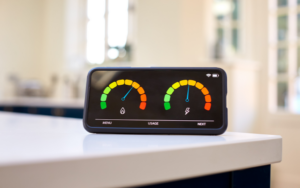
 Energy regulator Ofgem has announced that typical household energy bills will rise by £111 per year from 1st April 2025. It represents a 6.4% hike, meaning the average dual-fuel energy bill will rise from £1,738 to £1,849. To estimate how the latest rise is likely to impact your own energy costs you can simply add 6.4% to your energy bills, so those currently paying £150 per month will be paying around £159.60 come April.
The new energy price cap will be in place from 1st April 2025 to 30th June 2025 and is set by Ofgem, the energy regulator. While another energy price hike will come as disappointing news to consumers, the latest rise had been expected. We reported last month that energy prices were predicted to rise by around 6%, adding around £100 per year to the average dual-fuel energy bill.
With rising inflation and recent cuts to the winter fuel payment, many will be concerned about another increase in the cost of their energy. Below, we explain why energy bills are going up, how much you are likely to pay under the new price cap and what you can do if you are struggling to pay your energy bills.
Why have energy prices risen again?
Inflation and global politics play a significant role in energy prices and when inflation worsens, or we see conflicts like those in Ukraine or the Middle East intensify, then wholesale prices for gas and electricity tend to go up. The latest energy price cap rise has been driven by a number of factors, however, the main contributor is the significant increase in the wholesale price of international gas.
What is the energy price cap?
The energy price cap was introduced by the government's energy regulator Ofgem (Office of Gas and Electricity Markets) to control the maximum amount that providers are allowed to charge consumers for each unit of gas and electricity. Prior to the energy crisis, the price cap was reviewed every six months. However, with the wholesale energy market experiencing unprecedented volatility in 2022, Ofgem moved to a quarterly price cap review. The energy price cap represents the average annual dual-fuel household bill that is paid via direct debit.
The energy price cap is based on the average dual-fuel household bill and how much you will actually pay will vary depending on how much energy you use.
Energy price cap figures - 2019 to 2025
Below is a brief history of energy price cap figures going back to 2019.
| Date Energy Price Cap is effective from | Energy Price Cap |
| 1st October 2019 | £1,089 |
| 1st April 2020 | £1,073 |
| 1st October 2020 | £993 |
| 1st April 2021 | £1,084 |
| 1st October 2021 | £1,216 |
| 1st April 2022 | £1,887 |
| 1st October 2022 | £3,371 |
| 1st January 2023 | £4,059 |
| 1st April 2023 | £3,116 |
| 1st July 2023 | £1,976 |
| 1st October 2023 | £1,834 |
| 1st January 2024 | £1,928 |
| 1st April 2024 | £1,690 |
| 1st July 2024 | £1,568 |
| 1st October 2024 | £1,717 |
| 1st January 2025 | £1,738 |
| 1st April 2025 | £1,849 |
How much will you pay for energy under the new price cap?
The following table shows how much you can now expect to pay for each unit of gas and electricity. The figures will vary depending on where you live in the UK. Remember, the amount you pay under the new price cap will be based on your energy usage and the charges stated below, assuming you pay by direct debit.
| Current energy price per unit
(1st January - 31st March 2025) |
New energy price per unit
(1st April - 30th June 2025) |
|
| Electricity | Daily Standing charge: 60.97p
Unit price per kWh: 24.86p |
Daily Standing charge: 53.80p
Unit price per kWh: 27.03p |
| Gas | Daily Standing charge: 31.65p
Unit price per kWh: 6.34p |
Daily Standing charge: 32.67p
Unit price per kWh: 6.99p |
(Source: Ofgem)
Those without a smart meter should make a note to take a meter reading as close to the 31st March as possible to ensure your readings are accurate and you pay the correct price for your energy.
What will happen to the energy price cap in the future?
According to the latest predictions from energy analysts Cornwall Insight, the energy price cap could fall to around £1,756 in July 2025, the next point at which it can change. British Gas predicts that energy prices could reduce to around £1,785, while EDF is forecasting that prices could fall to around £1,810 per year in July 2025. What this goes to show is that energy price forecasting is complex and there is no certainty as to whether energy prices will rise or fall in the future.
In response to the latest energy price cap increase, Tim Jarvis, a spokesperson for Ofgem said "I recognise that this is very unwelcome news for consumers, many of whom have been struggling over the winter. The reason for today's increase, and the reason we're seeing upward pressure on prices is the changes in the international gas markets. We're seeing significant increases in the wholesale price of gas, and that's been driven by a number of factors, but they are international factors, and it is further evidence, that we need to move away from that reliance on international gas and start looking at domestically generated energy".
Ultimately, there are many factors that can influence the wholesale market price for gas and electricity, so if you are worried about future price rises, you may be better off considering a fixed price tariff. We explain more below.
Is now a good time to switch to a fixed energy tariff?
The energy price cap changes every 3 months, while fixed deals typically last 12 or 24 months. The danger with fixing your energy costs is that should you fix, a better deal may be just around the corner. Conversely, a fix may result in a relatively low bill if prices subsequently soar. The real benefit to fixing your energy deal is the assurance that you know exactly what you will be paying for your energy over a set period. While better deals could come to market during your fixed period, you are protected should there be a sudden surge in energy prices. However, there are more fixed energy deals coming to market that do not charge exit fees, leaving customers free to switch if a better deal becomes available.
We cover this tariff in more detail as well as a roundup of the best fixed-price energy tariffs on the market in our article 'What is the cheapest fixed price energy tariff? - Best deals compared'.
What to do if you're struggling to afford your energy bills
If the cost of energy is becoming overwhelming then your energy supplier may be able to help you arrange an affordable repayment plan. We provide some tips if you are struggling to afford your energy bills in our article 'How to save money on your energy bills'. There are also a number of grants and schemes available for those who are most vulnerable. More information and help on the cost of living can be found in our Cost of Living guide.

 MTTM AI (beta)
