
 Vanguard has confirmed it will significantly reduce the "home bias" in its popular LifeStrategy funds, cutting the allocation to UK shares and bonds. Head of Vanguard UK Adviser Solutions, Gillian Hepburn, said: 'As markets evolve, so does our approach to portfolio construction'. This move comes despite wider government efforts to encourage investment in domestic markets, with Vanguard among 19 financial firms helping to fund the government-backed UK Retail Investment Campaign, set to be launched in April.
The £52 billion LifeStrategy range is widely used by UK investors as a "one-stop-shop" for their portfolios. Historically, these funds have held a higher percentage of UK assets than the UK's actual size in the global economy would dictate - a strategy known as "home bias." Vanguard is now dialling this back to offer greater global diversification. In addition, Vanguard has announced other changes, including fee reductions and the launch of a new "Global" version of the LifeStrategy funds. In this article, we explain the major changes to the Vanguard LifeStrategy funds, including a full timeline and what they mean for existing Vanguard investors.
What is changing with the UK allocation?
Currently, the LifeStrategy funds have a target allocation of roughly 25% of their equity allocation in UK equities (shares) and 35% of their bond exposure in UK bonds. Under the new changes, both of these figures will be reduced to 20%.
- UK Equities - Dropping from 25% to 20%.
- UK Bonds - Dropping from 35% to 20%.
Why the change?
Vanguard states that while UK investors still value having some home bias, the "optimal" level has shifted. The UK market now makes up less than 4% of the global stock market. By holding 25% in the UK, Vanguard states that investors were missing out on growth in other major regions, such as the US.
Vanguard’s research suggests that a 20% allocation strikes a better balance - keeping enough UK exposure to manage currency risk and align with local inflation, while capturing more global growth.
When is this happening?
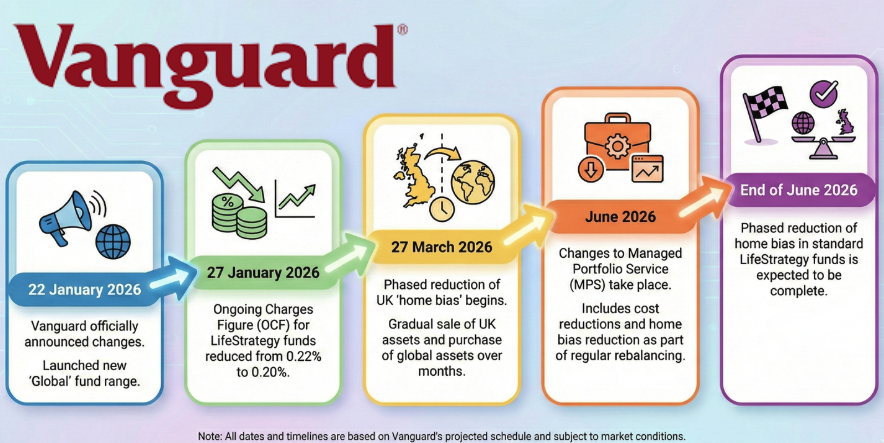
The changes will be phased in gradually between 27th March 2026 and June 2026. This phased approach is designed to minimise any potential disruption to fund performance.
What do I need to do?
If you are already invested in a LifeStrategy fund, you do not need to take any action. The rebalancing will happen automatically within the fund. However, this is a good opportunity to check whether the new allocation still aligns with your investment goals. While the UK weighting is decreasing, 20% is still significantly higher than a purely neutral global tracker (which would typically only hold around 4% in the UK).
Other Key Announcements
The changes extend beyond asset allocation, with investors set to benefit from lower fees and a new 'Global' fund range:
Fees are being cut
Vanguard is lowering the cost of investing in the LifeStrategy funds. The Ongoing Charges Figure (OCF) will fall from 0.22% to 0.20%. In addition, its LifeStrategy model portfolios will have their all-in costs reduced from 0.20%-0.23% to an estimated 0.17%-0.18%
- Effective Date - 27th January 2026 (LifeStrategy funds). June 2026 (Managed Portfolio Service)
- Benefit - This fee cut means you keep more of your investment returns. Vanguard estimates this will save UK investors over £10 million a year.
Launch of "LifeStrategy Global" funds
For investors who are not interested in having a "home bias", Vanguard has launched a completely new range of five LifeStrategy Global funds.
- How they work - These funds follow the same risk levels (e.g. 60% equity, 40% bonds), but invest in line with the geographical split of global equity and bond markets.
- UK Exposure - The new global funds will hold just 3-4% in UK assets.
- Date - The funds will be available as part of a phased rollout starting 22nd January 2026.
- Cost - These also come with the new lower fee of 0.20%.
Summary
Vanguard is updating its LifeStrategy funds to better reflect the modern global economy. By reducing its exposure to the UK, it believes it can capture higher growth from international markets while retaining enough UK assets to manage currency risks. For those who prefer a more global approach, the new 'Global' funds provide an alternative with less UK exposure.
If these changes have prompted you to review your investments, it is worth checking how your current provider compares to the competition. We track the performance of market-leading providers, including the popular Vanguard LifeStrategy 60% fund, in our article 'Which is the best performing Stocks and Shares ISA?'. We have recently updated our comparison tables with the latest 2025 data to show exactly how these funds compare to the competition.





 MTTM AI (beta)
