
 Gold is often viewed as an investing ‘safe haven’. It is a physical asset that cannot be easily created or destroyed, and over the long term, it's viewed as a store of value with the potential to keep pace with inflation. But with prices recently smashing through the historic $5,000 per troy ounce mark, many investors are wondering how to invest in gold and whether it’s too late to join the party.
In this article, we break down why gold is hitting record highs and how to invest in gold, as well as the associated risks.
Why is the gold price rising?
The meteoric rise in the price of gold is the result of a 'perfect storm' of overlapping macroeconomic and geopolitical factors that have increased the demand for gold throughout 2025 and into 2026. These include:
- Fear of currency devaluation: As national debts climb to record levels, investors worry that governments will print more money to pay their bills. This makes 'paper' money less valuable and encourages investors to trade their cash for 'hard' assets like gold.
- Central banks switching to gold: Central banks around the world have been moving away from the US dollar. By holding gold instead of foreign currencies, these banks are trying to protect their wealth from inflation and trade disputes.
- A weak US dollar: The value of the US dollar against a basket of global currencies has fallen by almost 12% since the start of 2025. As gold is priced in US dollars, when the US dollar falls in value gold becomes more attractive to buy for investors holding currencies other than the US dollar.
- Loss of trust in financial institutions: When investors feel that political pressure is interfering with how central banks manage the economy, they lose confidence in government-backed assets. This is currently true of the United States. Gold is therefore seen as a more secure alternative because it is independent of any government.
- Low interest rates: As gold doesn't pay interest, when interest rates are low and bonds offer poor returns, the 'opportunity cost' of choosing gold over other investments lessens. In other words, investing in gold becomes more attractive.
- Global conflict and trade wars: High-tension events like trade tariffs and international border disputes make markets nervous. During these times, investors pull money out of the stock market and move it into perceived 'safe haven' assets such as gold.
- Market strength and resilience: Even when large investment funds were forced to sell billions of dollars' worth of gold futures to balance their portfolios in mid-January 2026, the price of gold continued to rise. This showed that the demand for gold was strong enough to overcome temporary selling pressure.
- Fear of missing out: As the price of gold hits new records, more people join the market because they are afraid of missing out on future gains. This 'FOMO' (Fear Of Missing Out) creates a cycle that is currently pushing the gold price higher.
How high could the price of gold go?
Gold's trajectory in 2025 was truly historic, ending with a massive 65% gain that marked the metal's strongest annual performance since 1979. At the start of 2026, when the price of gold was at $4,332 per ounce, the consensus among major investment banks was that 2026 would be bullish for gold. Initial price targets for the end of 2026 were mostly clustered between $4,500 and $5,300 per ounce.
However, after gold rallied at the start of the year, it caused several institutions to reconsider their outlook. Last week UBS and Goldman Sachs raised their 2026 targets to $5,400, up from their previous forecasts of $5,000 and $4,900 respectively. This was not optimistic enough, with the price of gold already surpassing these targets after breaking above $5,600 per ounce. In the last few days, Deutsche Bank has raised its gold price target to $6,000. The chart below shows the scale of the gold price rally over the last year.

image source: Royal Mint
It is important to remember that investment banks are not immune to recency bias. This cognitive bias, common to almost all investors, involves the assumption that recent trends will persist into the near future. In the current gold market, this psychological tendency can lead to overblown optimism based solely on the latest price surge.
If the gold market takes a turn and prices begin to drop, some analysts believe that $5,000, possibly even $4,500, would serve as floors to the price of gold. A fall to $5,000 would represent a correction of roughly 10% from current price levels, whereas a pullback to $4,500 would be a 20% fall, and would fulfil the technical definition of a bear market, suggesting that market sentiment had become pessimistic.
Keep in mind that gold is an asset that pays no interest or dividends, and its price is extremely volatile. For example, the price of gold fell approximately 44% between 2011 and 2015.
How to invest in gold
There are several ways to invest in gold, ranging from holding the physical metal to buying investments that track the gold price. Below we set out the main options for investors:
Buy physical gold (bars and coins)
Buying physical gold is the most direct way to invest. You can purchase from government mints like The Royal Mint or established dealers such as BullionVault. Direct ownership is the only way to eliminate counterparty risk, which is the danger that a firm replicating gold prices might go bust. Later in this article I explain counterparty risk in more detail as it's particularly relevant when you invest in gold via Exchange Traded Commodities (ETCs) or an Exchange Traded Fund (ETF).
- Gold bar profits are taxable - Any profit made from buying and selling gold bars is subject to Capital Gains Tax (CGT). The CGT annual allowance of £3,000 can be used to reduce your tax liability. That means that if your capital gains from buying and selling gold bars do not exceed your available CGT annual allowance, then they will not be subject to CGT. Any capital gains in excess of your personal allowance will be taxed at 18% or 24%. The specific rate depends on your total taxable income; you pay 18% if you are a basic rate Income Tax payer and 24% if your income (plus the gain) falls into the higher rate Income Tax band. Bear in mind that you are only liable to pay CGT on profits made from investing in gold bars when you crystallise the gain (i.e. you sell the asset).
- Tax-free gains on gold coins - The Royal Mint classifies bullion gold coins, such as Gold Sovereigns and Britannias, as legal tender and as such are exempt from Capital Gains Tax (CGT). It means that any gains made from buying and selling bullion gold coins are tax-free. The Royal Mint has confirmed that the popularity of bullion coins has surged among investors due to their CGT-exempt status. This is partly because the annual CGT allowance has been reduced in recent years and now sits at just £3,000 per person per tax year.
- You can even buy a fraction of a gold coin - In 2014, the Royal Mint began allowing investors to buy coins as small as 1/10th of an ounce (priced at around £450 currently), rather than have to buy full ounce bullion gold coins (currently priced at around £4,200). Fractional gold coins allow investors to buy gold in smaller denominations, making gold coin investments more accessible. However, fractional gold coins carry a cost premium as the manufacturing cost are higher.
Costs
- Storage and Insurance - One of the issues when physically owning gold is security and storage. You can take home delivery if you purchase from the Royal Mint (but you will require a safe and suitable insurance) or you can store your gold bars or coins in a professional vault. The Royal Mint, for example, charges approximately 1% plus VAT annually to store gold bars or tubes of cold coins and 2% (plus VAT) annually for storing single gold coins.
For more information on investing in physical gold, including the pros and cons you can listen to our podcast episode 'MTTM Podcast Episode 471 – Investing in physical gold'.
Gold ETC or ETFs
Rather than owning physical gold, it is possible to invest in financial instruments that track the price of the precious metal. Exchange Traded Commodities (ETCs) and Exchange Traded Funds (ETFs) trade on stock exchanges, like shares, and are the easiest way to get exposure to gold within an ISA or SIPP. If they are held in an ISA or SIPP any gains made when investing in a gold ETC or ETF will be tax-free. If instead they are held outside of an ISA or SIPP, for example in a General Investment Account, any gains will be subject to tax.
There are three types of ETCs/ETFs and they differ in the way in which they track the price of gold. They are Physical, Synthetic and Sampled, which are explained below along with their pros and cons:
Physical (Full Replication)
This is generally considered the gold standard for retail investors and is the method used by popular funds like the iShares Physical Gold ETC (SGLN). With a physical ETC, the fund manager uses the investors' money to buy real, physical gold bars. These bars are then stored in a high-security bank vault, often held by a custodian like JPMorgan or HSBC.
- Pros: It is a direct and transparent way to track the price. Because the gold actually exists in a vault, there is very little 'tracking error' (the difference between the fund price and the gold price).
- Cons: You are reliant on the security of the vault and the honesty of the custodian, though these are regularly audited.
Popular examples of physical ETCs also include the Invesco Physical Gold. However, the Royal Mint Responsibly Sourced Physical Gold ETC (RMAP) is unique because it is 100% backed by gold bars held in The Royal Mint's vault. Unlike most ETCs, RMAP allows investors to potentially exchange their shares for physical gold coins or bars.
Synthetic (Swap-Based)
Synthetic ETCs do not own any physical gold. Instead, they use complex financial contracts to mimic the price movement of gold. With a synthetic ETC, the fund enters into a legal agreement (a 'swap') with a third party, usually an investment bank. The bank promises to pay the fund the exact return of the gold price in exchange for a fee.
- Pros: Sometimes, synthetic ETCs can have lower management fees because there are no physical storage or transport costs.
- Cons: Synthetic ETCs carry significant counterparty risk. If the bank providing the swap goes bust, the investment could vanish, even if the gold price is soaring. Synthetic ETCs use derivatives instead of owning the physical metal and their performance can diverge from the gold price over time.
Sampled (Optimised Replication)
Sampling is more common in stock market ETFs, but you may occasionally see it in broader precious metals or commodity ETFs/ETCs that track a basket of different metals. Instead of buying every single type of asset in an index, the fund buys a 'sample' of the most important or liquid ones that it believes will accurately represent the whole. In a gold context, a sampled fund might hold a mix of physical gold and gold-related derivatives to stay flexible.
- Pros: It can be more cost-effective for funds that track a wide range of different commodities or miners at once
- Cons: It can lead to 'tracking error', where the fund doesn't perfectly match the movement of the spot gold price because the 'sample' isn't a 100% match of the market. Sampled ETCs can also carry counterparty risk.
Cost of investing in gold ETCs or ETFs
In order to invest in an ETC or an ETF you will need to use an investment platform. The investment platform will usually charge a platform fee, which varies but generally works out between 0.15% and 0.35% per annum, depending on the size of your investment and the platform you choose. In addition to the platform fee, you will have to pay the underlying charge of the ETF or ETC you invest in, which can be as low as 0.12% per annum. We provide a roundup of the cheapest stocks and shares ISAs as well as the cheapest SIPPs available in the UK.
Gold mining shares
One way of gaining exposure to gold is by investing in the shares of gold mining companies. You could buy the shares directly or via a fund that owns shares of a range of gold mining companies. These funds can take the form of a unit trust, such as BlackRock Gold & General, or an ETF like VanEck Gold Miners ETF. However, gold mining shares are extremely volatile as it introduces an element of operational leverage. Because miners have high fixed costs, a small rise in the gold price can lead to a much larger jump in profits (e.g. a 20% gold price rise could lead to a 60% jump in profit). A rise in profits is usually positive for the company's share price. Conversely, operational leverage can work in reverse; falling gold prices or rising operational costs (like energy or labour costs) can quickly wipe out profit margins and send mining share prices tumbling. In addition, investors face operational risks like mine accidents, geopolitical instability in mining regions and general stock market volatility, which will impact their investments.
Costs
To invest in gold mining shares via an ETF or unit trust, you will need to use an investment platform in order to make your investment, which will typically charge an annual fee. In addition, you will need to pay the annual charge of the fund you wish to invest in, which usually ranges between 0.12% and 1.2% per annum.
For more information on investing in gold mining shares as well as the pros and cons listen to our podcast episode 'MTTM Podcast Episode 523 – Investing in gold miners'.
Digital gold
A more modern alternative to owning physical gold is Digital Gold, known as DigiGold. The Royal Mint describes DigiGold as a "simple and cost-effective way to own physical gold, silver and platinum in quantities to suit all budgets, allowing you to purchase and own a fractional amount of large gold, silver and platinum bars that are held securely in The Vault. These large bars allow us to offer economies of scale and pass on the savings to customers. Unlike buying coins or bars, it enables you to purchase gold, silver and platinum based on value rather than weight e.g. £25 instead of a 1 ounce coin or bar, providing you with control and flexibility".
Difference between Digital Gold and investing in physical gold bars or coins
Although DigiGold allows investors to own gold, it is very different to investing directly in gold bars and gold coins. The table below summarises the key differences:
| Feature | Physical Gold (Coins/Bars) | DigiGold (Digital Gold) |
| Minimum Investment |
Price of the smallest coin (e.g.£450 for 1/10oz)
|
As little as £25
|
| Ownership Type | Allocated: You own a specific, identifiable item | Unallocated: You own a share of a pool |
| Delivery |
You can take home delivery or store it
|
You cannot take delivery of DigiGold; it must remain in the vault
|
| Management Fees |
Storage fees (e.g., 1–2% +VAT annually) if vaulted
|
Lower management fees, typically 0.5% + VAT per year
|
| Tax Status (UK) | Sovereigns/Britannias are CGT-exempt. | Generally subject to Capital Gains Tax. |
DigiGold doesn't attract the 'premium' cost that is often associated with fractional bullion gold coins.
See how much gold I hold in my own investment portfolio
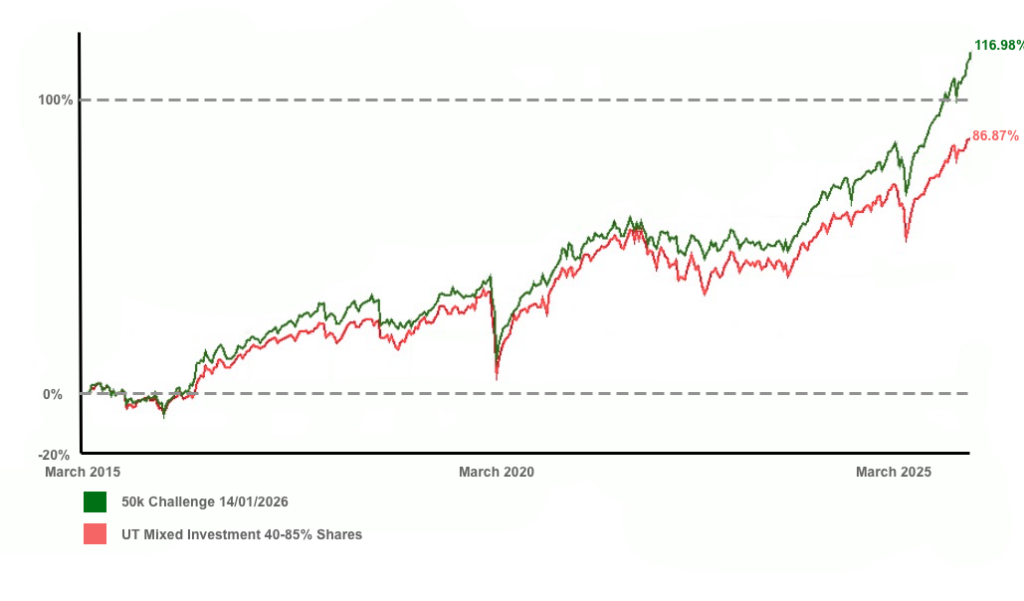
As part of our 80-20 Investor DIY-investing service, I have run an investment portfolio live for subscribers for almost 11 years. My portfolio has more than doubled in value (from £50,000 to over £108,409). While my portfolio invests primarily in a diversified mix of equity and bond funds, it also includes a core investment in gold. If you wish to see all of the investments in my portfolio (including my gold holding), as well as the associated allocations, you can take out a FREE 30-Day trial of 80-20 Investor.
The chart below shows the performance of my portfolio (the green line) versus the average professionally managed fund from the Mixed Investment 40-85% Shares sector (the red line) since my portfolio's inception.
When investing, your capital is at risk and you may get back less than invested. Past performance doesn’t guarantee future results.



 MTTM AI (beta)
