
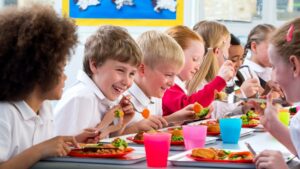
 500,000 more children in England will benefit from free school meals from September 2026, following recently announced rule changes. From September 2026, all children in families that claim Universal Credit will be eligible for free school meals. Currently, children are only eligible for free meals at school if their household income is less than £7,400.
Analysis by the government suggests that there will be 150,000 fewer people in relative poverty by 2030 as a result of the free school meals expansion. This estimate also includes 100,000 fewer children in relative poverty. In the long run, around 1.7 million school children will benefit from free school meals, according to the Institute for Fiscal Studies. On an individual level, the change will save parents an average of £500 per year.
Work and Pensions Secretary Liz Kendall said: "Poverty robs children of opportunities and damages their future prospects. This is a moral scar on our society we are committed to tackling. By expanding Free School Meals to all families on Universal Credit, we’re ending the impossible choice thousands of our hardest grafting families must make between paying bills and feeding their children."
The government is also working with experts across the sector to ensure that the meals provided are of high quality and nutrition, and to ensure that all schools are supported with the latest nutrition guidance.
This latest move is part of the government's Plan for Change, which aims to break down barriers to opportunity. It comes ahead of the government's Child Poverty Taskforce strategy which is due to be published later this year.
Who will be eligible for the free school meals from September 2026?
All children whose household receives Universal Credit will be eligible for free school meals. This includes children in all settings where free school meals are already delivered, such as school-based nurseries, schools, and Further Education settings. As such, the change will impact children from nursery age right through to sixth form.
Prime Minister Keir Starmer added: "Working parents across the country are working tirelessly to provide for their families but are being held back by cost-of-living pressures. My government is taking action to ease those pressures. Feeding more children every day, for free, is one of the biggest interventions we can make to put more money in parents’ pockets, tackle the stain of poverty, and set children up to learn."
While some local authorities, such as the Greater London Authority (GLA), have similar schemes in place, they typically only cover primary schools. Within GLA, for example, all primary-aged children in state-funded schools are entitled to free school meals regardless of whether their parents receive benefits or not. In addition, all students in reception through to year two in England are eligible for free school meals.
However, this new initiative means that older children of parents on Universal Credit will receive free meals too.
How can parents apply for free school meals for their children from September 2026?
There isn't a process in place yet to apply for the extended free school meals. However, the government expects that the majority of schools will allow parents to apply before September 2026. They will likely need to provide their National Insurance Number as part of the application process, so that their eligibility can be checked.
What other help can parents expect from the government?
The extended free school meals initiative is part of the government's Plan for Change. Other measures the government introduced recently include the roll out of free breakfast clubs which provide around 180,000 students in the most disadvantaged communities access to 30-minute sessions before school where free breakfast is provided. In addition, the expansion of government-funded childcare to 30 hours a week for working parents of 9-month-olds is now in place, and eligible parents will be able to benefit from September 2025.
Later this year, the government's Child Poverty Taskforce is also due to publish its ten-year strategy designed to support families living in poverty. It's unclear yet what will be in the strategy, but a government document published in October last year suggested it would work to tackle the root causes of poverty, and in particular, employment and housing issues. As part of the strategy, the taskforce will look at ways to increase parental incomes and, in particular, how childcare can help to enable parental employment.
Organisations such as Child Poverty Action Group have called on the government to scrap the two-child benefit cap as part of the Child Poverty Taskforce's strategy. The cap means that families with more than two children born after April 2017 can't claim certain means-tested benefits. Education Secretary Bridget Philipson has confirmed the government is considering scrapping the two-child benefit cap, but has stressed that any announcements regarding this policy will be made as part of the Child Poverty Taskforce strategy.






 MTTM AI (beta)
