
 The Monetary Policy Committee (MPC) at the Bank of England (BoE) has voted to hold the base rate at its current level of 3.75%. The members of the committee voted 9-0 to maintain the base rate, with no dissenting members voting for a point cut.
Though a unanimous decision is unusual, the decision to hold was expected.
The energy market turmoil caused by the war in the Middle East has triggered a global economic shock and could provoke another cost-of-living crisis in the UK. Oil prices have soared above $100 a barrel and European gas prices have almost doubled, amid warnings that a prolonged conflict could have far-reaching effects on global living standards.
In response, the Bank of England has chosen to hold the base rate as part of a 'wait-and-see' approach. In its published summary of the decision, the MPC said: "The Committee will continue to monitor closely the situation in the Middle East and its impact on global energy supply and energy prices. It stands ready to act as necessary to ensure that CPI inflation remains on track to meet the 2% target in the medium term."
This action could come sooner rather than later, with markets predicting at least two quarter-point base rate increases this year.
What is the Bank of England base rate?
The Bank of England base rate determines how much the BoE pays commercial banks for holding money with it. This then influences how much those banks charge customers to borrow money or pay customers who deposit savings with them.
If the base rate goes down, it usually triggers a drop in the interest rate that banks and other lenders charge the public to take out loans, mortgages and credit cards, as well as the interest rate they pay out on savings. A base rate hike will usually mean interest rates are increased, and when the base rate is held, providers may still change rates, depending on the future economic outlook.
Why has the Bank of England held the base rate?
The Bank has chosen to hold the base rate in order to "assess how events unfold", according to the governor, Andrew Bailey.
He said: "War in the Middle East has pushed up energy prices. You can already see that at the petrol pump and, if it lasts, it will feed into higher household energy bills later in the year."
Cutting the base rate, as had been expected before the military strikes in the Middle East, could increase inflation when it is already set to rise sharply. In contrast, hiking rates could be seen as a heavy-handed reaction to an extremely volatile conflict that has proven impossible to predict.
The effective closure of the Strait of Hormuz - a narrow waterway vital for global trade that handles roughly 20% of the world's daily oil and seaborne liquefied natural gas (LNG) - has been the core trigger of the energy shock. Bailey warned: "Monetary policy cannot reverse this shock to supply. Its resolution depends on action taken at its source to restore the safe passage of shipping through the Strait of Hormuz."
Ultimately, the MPC has decided to wait for events to unfold before it makes its next move. However, while the Bank of England cannot control global economic crises, it will be concerned that higher energy costs will push up the price of everyday goods and services. The Bank's economists had calculated that inflation could hit 3.5% in the coming months, a long way from its 2% target, which it had expected to hit in the second quarter of 2026 prior to the Middle East conflict. Some reports have suggested that events have already moved so fast that these numbers are already out of date, with a 4% inflation figure more likely.
Where will interest rates go in 2026?
In a complete reversal of the situation before the war in the Middle East, an interest rate increase is now fully priced in by the swaps market. A quarter-point hike by July - taking the rate back up to 4% - is expected to be the Bank's response to the energy crisis, and further hikes could follow.
However, this depends almost solely on events in the Middle East. A normalisation of travel through the Strait of Hormuz, a de-escalation of the conflict, or evidence of a clearer long-term plan for the region could ease price pressure and encourage the Bank to change tack.
In contrast, an escalation of attacks on energy production sites, not just trade routes, could see the economic shock worsen and push the Bank to move faster to curb a new inflation crisis. Restricting the movement of key fuels has caused an economic shock, but this can quickly be recovered once routes are reopened. However, damage to the infrastructure that produces these fuels could take years to repair.
If you are interested in learning more about where interest rates might go in the future, check out our article on the latest UK interest rate predictions.
How has the BoE base rate changed over time?
The graph below shows how the Bank of England base rate has dramatically dipped and soared over time, either side of long periods of stability.
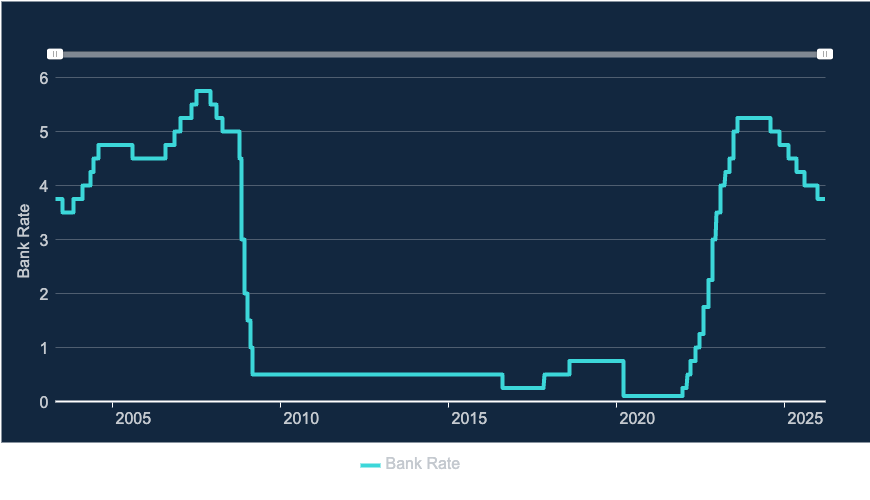
(Source: Bank of England)
Base Rate changes and how they impact you: December 2021 - March 2026
The table below shows the impact of the base rate decisions by the Bank of England since December 2021 on a £100,000 mortgage borrowed over 25 years:
| Date | Interest rate change | Previous interest rate | New interest rate | Change to average monthly mortgage repayments per £100k borrowed* |
| 16th December 2021 | +0.15% | 0.10% | 0.25% | +£8 |
| 2nd February 2022 | +0.25% | 0.25% | 0.50% | +£13 |
| 17th March 2022 | +0.25% | 0.50% | 0.75% | +£13 |
| 5th May 2022 | +0.25% | 0.75% | 1.00% | +£13 |
| 16th June 2022 | +0.25% | 1.00% | 1.25% | +£13 |
| 4th August 2022 | +0.50% | 1.25% | 1.75% | +£26 |
| 22nd September 2022 | +0.50% | 1.75% | 2.25% | +£26 |
| 2nd November 2022 | +0.75% | 2.25% | 3.00% | +£39 |
| 15th December 2022 | +0.50% | 3.00% | 3.50% | +£26 |
| 2nd February 2023 | +0.50% | 3.50% | 4.00% | +£26 |
| 23rd March 2023 | +0.25% | 4.00% | 4.25% | +£13 |
| 11th May 2023 | +0.25% | 4.25% | 4.50% | +£13 |
| 22nd June 2023 | +0.50% | 4.50% | 5.00% | +£26 |
| 3rd August 2023 | +0.25% | 5.00% | 5.25% | +£13 |
| 21st September 2023 | +0.00% | 5.25% | 5.25% | £0 |
| 2nd November 2023 | +0.00% | 5.25% | 5.25% | £0 |
| 13th December 2023 | +0.00% | 5.25% | 5.25% | £0 |
| 1st February 2024 | +0.00% | 5.25% | 5.25% | £0 |
| 21st March 2024 | +0.00% | 5.25% | 5.25% | £0 |
| 9th May 2024 | +0.00% | 5.25% | 5.25% | £0 |
| 20th June 2024 | +0.00% | 5.25% | 5.25% | £0 |
| 1st August 2024 | -0.25% | 5.25% | 5.00% | -£13 |
| 19th September 2024 | +0.00% | 5.00% | 5.00% | £0 |
| 7th November 2024 | -0.25% | 5.00% | 4.75% | -£13 |
| 19th December 2024 | +0.00% | 4.75% | 4.75% | £0 |
| 6th February 2025 | -0.25% | 4.75% | 4.50% | -£13 |
| 20th March 2025 | +0.00% | 4.50% | 4.50% | £0 |
| 8th May 2025 | -0.25% | 4.50% | 4.25% | -£13 |
| 19th June 2025 | +0.00% | 4.25% | 4.25% | £0 |
| 7th August 2025 | -0.25% | 4.25% | 4.00% | -£13 |
| 18th September 2025 | +0.00% | 4.00% | 4.00% | £0 |
| 6th November 2025 | +0.00% | 4.00% | 4.00% | £0 |
| 18th December 2025 | -0.25% | 4.00% | 3.75% | -£13 |
| 5th February 2026 | +0.00% | 3.75% | 3.75% | £0 |
| 19th March 2026 | +0.00% | 3.75% | 3.75% | £0 |
| TOTAL | £190 |
*assumed mortgage term of 25 years
How does the Bank of England interest rate decision affect mortgages?
Fixed-rate mortgage customers
Anyone with a fixed-rate mortgage will not see their mortgage rate or monthly repayments change as a result of the BoE's decision to hold rates at this review. If your deal is due to end soon, you should still consider how mortgage rates might change in the coming months. Our article 'Will interest rates continue to fall in 2026' provides some insight into remortgaging and what to do if you are due to remortgage soon. If your mortgage deal is due to end in less than 6 months you can start to shop around and it is beneficial to speak to a mortgage adviser. Mortgage interest rates have begun to move upwards, with lenders repricing frequently, so securing a good deal when it comes up could provide significant savings on your new monthly mortgage payment and the overall cost of your mortgage.
It is worth remembering that if your current fixed-rate deal was in place prior to December 2021 (before rates first started going up), then you should factor in all of the subsequent base rate rises and cuts in order to budget for the likely increase in your monthly mortgage repayments after you remortgage. As shown in the table above, this equates to a monthly increase of around £190 per £100,000 borrowed, based on a 25-year mortgage term.
Many borrowers choose to extend their mortgage term when arranging new mortgages or remortgaging existing deals, in order to make monthly repayments more affordable. This may help in the short-term for those struggling with higher mortgage interest rates but it will mean that the debt is carried further into the future and will end up costing them more in interest payments over the long-term. Extending your mortgage term should be considered carefully with the help of an independent mortgage expert*.
Variable rate or tracker mortgage customers
Those with tracker or variable-rate mortgages tend to see their mortgage rates (and monthly repayments) change in line with the moves in the base rate. If you wish to see what a future rate cut or hike by the Bank of England would do to your monthly mortgage payment, you can use our interest rate calculator. You will need to know your initial mortgage term, the amount you borrowed at the start of the deal and your current mortgage rate.
Anyone wanting to know more about how rate rises and cuts impact their finances should speak with an independent mortgage adviser* as they can provide specialist advice. When considering remortgaging, always check for any Early Repayment Charges (ERC) and the remaining term of your current mortgage deal. Take a look at the best mortgage deals by using our mortgage rate comparison tool or checking out our article 'Best mortgage rates in the UK'.
Help if you're unable to afford your mortgage payments
Many mortgage holders continue to face rising mortgage costs due to the rise in mortgage interest rates since 2021. If you are worried about how you will afford your mortgage, then you should get in touch with your lender as soon as possible. Your lender should be able to find a solution that can help ensure no repayments are missed.
Potential solutions can include extending the length of your mortgage, converting part or all of your repayment mortgage to an interest-only mortgage or allowing you to take a mortgage payment holiday.
Check out our article 7 tips for dealing with mortgage arrears, or alternatively, you may find additional support from the following organisations helpful:
How does the Bank of England base rate decision affect you if you have credit cards, loans or overdrafts?
Credit cards
If you have an existing credit card with an agreed interest-free period or promotional interest rate you shouldn't notice any impact from a Bank of England base rate announcement.
Keep in mind that 0% credit cards are the best way to avoid any base rate fluctuations, by not paying interest at all. For example, by moving your existing credit card balance to a 0% balance transfer credit card, you ensure you pay no interest on your repayments if the balance is repaid within the promotional interest-free period. Be aware that most (not all) balance transfer credit cards charge a balance transfer fee, usually somewhere between 2% and 5%. Find out more in our article, 'Best 0% balance transfer credit cards'.
Loans
If you already have a loan with a fixed interest rate then you are unlikely to be affected whether the base rate is changed or not. If you are looking for a new loan then you can compare the best loan deals in our article, 'Best personal loans'.
Overdrafts
The interest rate charged on your overdraft may be affected as a result of the base rate rising or falling. If your bank or building society is going to change the rate of interest charged, you should receive a notification in advance, but it can take time for the change to be communicated.
How does the Bank of England base rate decision affect you if you have savings?
Although interest rates on savings accounts can remain unaffected when the base rate is held, some lenders may change interest rates on savings products, and existing savings promotions may be pulled from the market. You may see changes in the interest rate paid on your savings account, unless you have a fixed-rate account, over the coming weeks and months.
Our article, 'How to get more than 5% interest on your savings' summarises some of the best rates on the market and our regularly updated article 'Best savings accounts in the UK' provides a summary of the best savings rates for personal and business accounts.
Looking for the top savings rates should always involve shopping around for the right deal. You can check out the highest savings rates using our Savings Best Buy tables. Right now you can get as much as 7.5% interest on a Regular Saver account.
If a link has an * beside it this means that it is an affiliated link. If you go via the link Money to the Masses may receive a small fee which helps keep Money to the Masses free to use. But as you can clearly see this has in no way influenced this independent and balanced review of the product. The following link can be used if you do not wish to help Money to the Masses - VouchedFor



 MTTM AI (beta)
